top of page

Instant  Feels

Subscribe to the blog

Search

Are you more like Dory, Nemo, or your own kind of fish? How and what do you remember?


Animated movies often help us to understand complex topics and show us diversity. In "Finding Nemo" one of the main takeaways is that memory functions differently from one person to another. Some people struggle to remember names, locations, people they have just met and have some memory impairments like Dori, while others, like Nemo, do remember detailed plans and lessons learned in the past.


Some people are neither Dory or a Nemo and they are their own type of fish. I call them the Rainbow fish. Those people can remember an incredible amount of information in a short time.


Fascinating examples of such people who won many memory competitions are:


  Yanjaa Wintersoul


Yanjaa Wintersoul remembers the names of every audience member after looking at them for less than a minute.


Nelson Dellis


He won the USA Memory Championship multiple times. He can remember 339 digits in 5 minutes.


Simon Reinhard


He remembered 52 cards in 21.90 seconds and is a Speed Cards Memory World Record Holder.


How do they remember it all?


Yanjaa Wintersoul shares her own tactic in a 4-minute video and explains how her storytelling approach helps her win competitions. She suggests that this could improve anyone's memory. I have tried it, and it is cool but verify for yourselves.


Nelson Dellis associates each digit (0–9) with specific consonant sounds. Once you map the numbers to sounds, you combine them with vowels to form words. Watch the video to learn how.


Simon Reinhard discusses the method of loci, a memory technique used by ancient civilisations such as the Greeks and Romans. It trains the brain to associate numbers with specific locations.


Of course, most of us are not like them. So what does research say about the memory of an adult?


Interesting few research facts:


1) Extensive media multitasking (use of multiple media screens at the same time) impairs memory and working memory function. Uncapher, Thieu, and Wagner (2016) found that heavy use of multiple media screens reduces precision in recalling goal-relevant information.


2) Healthy adults remember real-world objects better than photographs of the same objects. Snow et al. (2014) demonstrated this in two experiments involving 172 participants, highlighting the advantage of tangible or realistic stimuli for memory retention.


3) Color enhances memory performance by increasing attention. A literature review by Dzulkifli and Mustafar (2013) concluded that the use of color can improve information retention, likely through its impact on attentional processes.


Key questions: What do you remember? What do you think about those research findings? Do any of them resonate with you? Comment bellow


References:


Snow JC, Skiba RM, Coleman TL, Berryhill ME. (2014) Real-world objects are more memorable than photographs of objects. Front Hum Neurosci. Oct 20;8:837. doi: 10.3389/fnhum.2014.00837. PMID: 25368568; PMCID: PMC4202719.


Uncapher MR, K Thieu M, Wagner AD. (2016) Media multitasking and memory: Differences in working memory and long-term memory. Psychon Bull Rev. Apr;23(2):483-90. doi: 10.3758/s13423-015-0907-3. PMID: 26223469; PMCID: PMC4733435.


Dzulkifli MA, Mustafar MF. (2013) The influence of colour on memory performance: a review. Malays J Med Sci. Mar;20(2):3-9. PMID: 23983571; PMCID: PMC3743993.


Disclaimer: All images were generated using AI through my personal subscription. All referenced articles are available under free-use or open-access copyright licenses and may be cited freely. The content presented reflects my own ideas and personal interest in this topic, and the way I wrote it is copyrighted.



Updated: Sep 22, 2025

Loss has many shapes. Some losses are loud, breaking the air with sorrow and pain. Others are soft, almost invisible, hidden from the public's eye, yet still there.


I have witnessed loss and the grief that followed in many forms: a wife who lost her husband to illness, a colleague who mourned a missed job opportunity, a person who was forced to leave behind home and identity, a friend who said goodbye to her father, a woman who lost her child in the fifth month of pregnancy, a pet owner who grieved a loyal companion, an acquaintance who lost the ability to walk after a motorbike accident, and a devoted partner who was heartbroken by the break of their marriage due to infidelity.


The stories are different, yet the same: they carry absence, longing, grieving, and the slow reshaping of life around what is gone. Put in a diagram, those losses can be divided into seven categories.


While exploring the literature for each type of loss, the information made me think and reflect, and I hope that you find them interesting, too. Below are a few evidence-based studies under each topic.


Loss of a parent/relative


I found the recent paper by Chan, Lee, and Tsing (2025) on grieving adults particularly thought-provoking. The study revealed that even individuals in late adulthood, whose parents passed away in their eighties or nineties, viewed their parents’ deaths as sudden and unjust. For some participants, one of the greatest challenges was the loss of unconditional love and support that they thought could only come from their parents. Others expressed feelings of loneliness, especially those who had lived with or regularly cared for their deceased parents. This raises an important question: is this reaction shaped by cultural context, given that the research was conducted in Hong Kong, or is it a universal experience that we in Western societies can relate to as well?


Loss of a child


Research clearly shows that the loss of a child might occur due to many reasons. You might lose a child due to miscarriage, due to illness, or due to an accident. However, I believe the most striking recent case that I am sure most of you read about is that of Adam, who suicided with the help of OpenAI.


Loss of a child due to suicide brings an incredible dilemma for the parents: Was I good enough? What did I do wrong? It can evoke a complex mix of difficult emotions: guilt, shame, confusion, anger, and many others (Young et al., 2012). In my opinion, calming a parent's heart after such an event is one of the most profound challenges and requires a long time. It requires a lot of patience and support from people around those individuals. The question is: Is society ready to invest significant time and support, while accepting that these individuals will experience ups and downs and may not always perform at their best in daily work?


Loss of a partner


I found the research project LIVES on Intimate Partner Loss very interesting. One part of the collected self-reported data questioned 388 adults about their willingness to search for professional support after the loss of an intimate partner. The results showed that professional help-seeking was higher after separation (57%) and divorce (49%), compared to widowhood (18%) (Jopp et al, 2021). The question remains: why are widowed individuals less likely to search for help?


Loss of an animal


This topic was explored in detail in my previous blog post. You can read my thoughts on it and find evidence-based information in it.


Loss of a job


Many people may not realise the connection between job loss and grief. It is not only connected, but it can lead to complicated grief (Eeresel, Taris, Boelen, 2020). Complicated grief is defined as a reaction in response to death that is profoundly overwhelming, and the passage of time fails to lessen the emotional suffering or restore normal functioning (APA, 2025). Interestingly, several factors may lead to the development of complicated grief. A study of 485 Dutch workers, who had experienced job loss, identified three potential risk factors: 1) holding a belief that the world is unjust, 2) having low self-esteem, and 3) relying on maladaptive coping strategies. I wonder, could support from loved ones help in this process? What are the safety net factors?


Loss of health/ certain abilities


I was touched by the story of the 37-year-old woman with Multiple Sclerosis (Moghadasi, 2019). Through the paintings, the lady expressed her perception and grief regarding her progressive disability. The balloon she drew represents the farewell to her former abilities and the better days of the past. She tries to come to terms with the fact that she lost her old life and abilities. In a way, her ability to draw helps to express her feelings. I wonder what it must be like for people who don’t have art as an outlet to express their frustration about losing their health. And does this kind of experience also apply to other health challenges?


Loss of home/ identity due to migration


Migration can involve a range of losses, which can be categorized as interpersonal, material, and abstract (Renner, Schmidt, & Kersting, 2024). Interpersonal losses refer to the loss of relatives and friends, material losses include the loss of home and income, and abstract losses encompass the loss of status, social roles, identity, language, plans, dreams, or the familiarity of one’s surroundings. Such losses may result in profound grief experiences. Nevertheless, this area remains under-researched; a recent systematic review identified only five studies on the subject, and their overall quality was low (Renner, Schmidt, & Kersting, 2024).


Short, important conclusion and a further question


The same truth applies to every kind of loss: it’s never easy to part with someone or something that truly matters. Yet, an important question arises—does every kind of loss inevitably bring grief, or can some losses also bring relief or even both? I leave this for you to reflect on, and I’d love to hear your thoughts in the comments below.


References :


APA (2025) APA Dictionary of Psychology, Available at: APA Dictionary of Psychology


Chan W.C.H , Leeb W.C., Tsing R. W. M (2025). Grieving the loss of parents: A qualitative study of bereaved adult children who received professional support, doi: https://doi.org/10.1080/07481187.2025.2513986


Moghadasi A. (2019) "Disability Grief": A patient's allegorical expression of her disability, Iran J Neurol, 18(4):190–191.


Renner A, Schmidt V, Kersting A (2024). Migratory grief: a systematic review. Front Psychiatry. doi: 10.3389/fpsyt.2024.1303847


Jopp D., Lampraki C, Meystre C, Znoj H, Brodbeck J (2021). Professional Support After Partner Loss: Likelihood and Correlates of Help-Seeking Behavior, doi: 10.3389/fpsyg.2021.767794


Young T.I., Iglewicz A., Glorioso D., Lanouette N., Seay K, Ilapakurti M, Zisook S. (2012). Suicide bereavement and complicated grief. doi: 10.31887/DCNS.2012.14.2/iyoung


Van Eersel J, Taris T, Boelen P (2020) Complicated grief following job loss: Risk factors for its development and maintenance. doi: 10.1111/sjop.12650


Updated: Aug 26, 2025


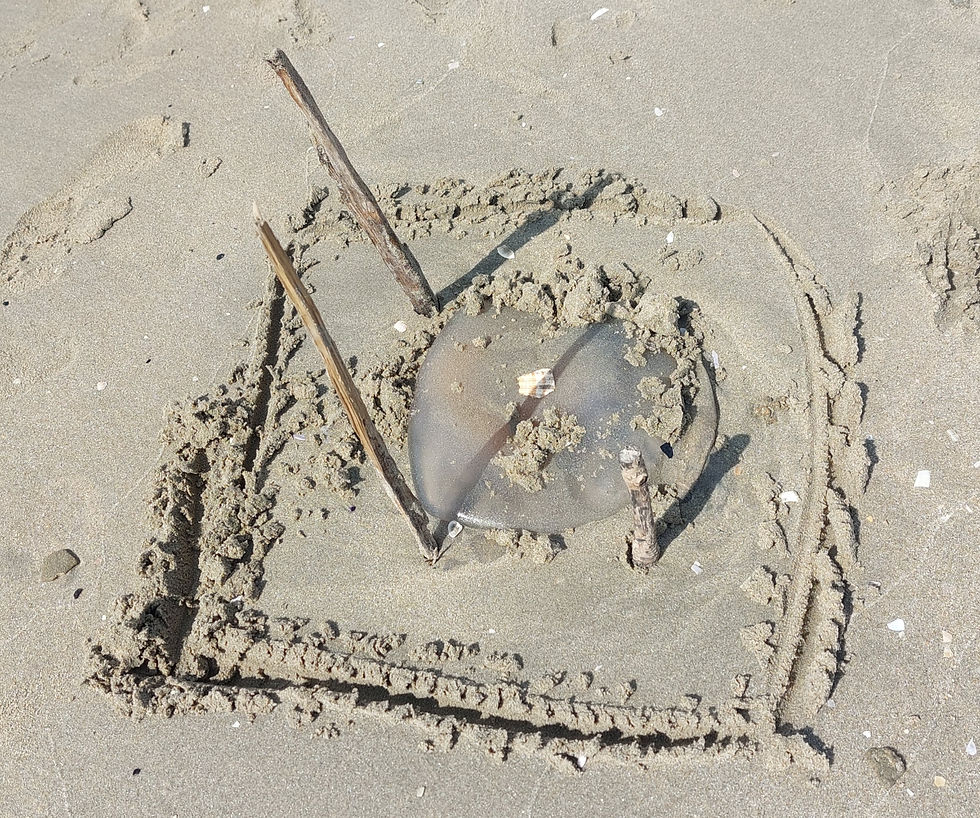
I saw a grave. Not any grave but a sand grave. Not in a graveyard but on the beach. But how could it be?


Jellyfish grave
Jellyfish grave

I was walking down the beach, and I saw familiar scenes: children sculpting various sand figures, such as turtles, sharks, and sandcastles; adults sunbathing or swimming in the sea. Nothing seemed out of the ordinary. Never would I have imagined that after half an hour of walking, I would stumble upon something unexpected: two children with their father carefully shaping a grave for a jellyfish. They were outlining the dead body with sticks, decorating with seashells, putting sand on the top, and tracing a square around it. The children were singing a song. Curious, I greeted the father, introducing myself, and asked if he would mind sharing what was happening. He smiled and began to tell me their story. A few months earlier, the family had lost their beloved dog to illness. For six years, that dog had been an incredible companion, and the loss had left them all in deep pain. As the children played close to the sea, they saw a lifeless jellyfish. To them, it didn’t feel right to simply leave it there alone. Remembering how their own dog had been buried, they decided the jellyfish, too, deserved the same respect—a grave of its own.


Is it normal to feel his way?


Yes, it is. In fact, animal grief following the loss of a pet can be just as profound and challenging as grief after the death of a human loved one (Clearly et al., 2022), and it is far from uncommon. Reports of such grief have been documented across countries for decades. An example is an early Canadian study from the 2000s in which approximately 30% of participants experienced severe grief following the death of a dog or cat (Adams et al., 2000). Reported reactions included both physical and emotional symptoms such as insomnia, loss of appetite, a deep sense of emptiness, persistent preoccupation with memories of the deceased pet, and intense difficulty accepting the absence of the animal in familiar places. Similarly, a more recent study from 2013 in Japan revealed that 56.1% of pet owners experienced severe grief. This research included owners who had lost not only dogs and cats, but also chickens, parakeets, rabbits, and hamsters.


An understanding of the depth and recurrence of loss emerges not only from academic literature but also from professionals' practice.


TedTalk by veterinarian Sarah Hoggan

Sarah Hoggan, an emergency veterinarian with over 20 years of experience, has witnessed countless pet owners grieving the loss of animals of all kinds. She describes in detail the complex emotions people feel in the face of loss, while also emphasising how society often diminishes or overlooks them.


All information above highlights that if you are struggling with the loss of a pet, you are certainly not alone. Given the depth of pain that you and others may experience, here is a question to you: Is it better to have loved and lost than never to have loved at all?  Share your thoughts in the comments below.


References


Clearly M., West S., Thapa D., Westman M., Vesk K., Kornhaber R. (2022) Grieving the loss of a pet: a qualitative systematic review. DOI: 10.1080/07481187.2021.1901799


Adams C., Bonnett B, Meek A. (2000) Predictors of owner response to companion animal death in 177 clients from 14 practices in Ontario. DOI: 10.2460/javma.2000.217.1303


Kimura J, Kawabata H, Maezawca M. (2013) Frequency of neurotic symptoms shortly after the death of a pet, Journal of Veterenary Medical Science. DOI: 10.1292/jvms.13-0231


© 2035 by Personal Life Coach. Powered and secured by Wix

bottom of page