Grief on the beach

Updated: Aug 26, 2025
I saw a grave. Not any grave but a sand grave. Not in a graveyard but on the beach. But how could it be?
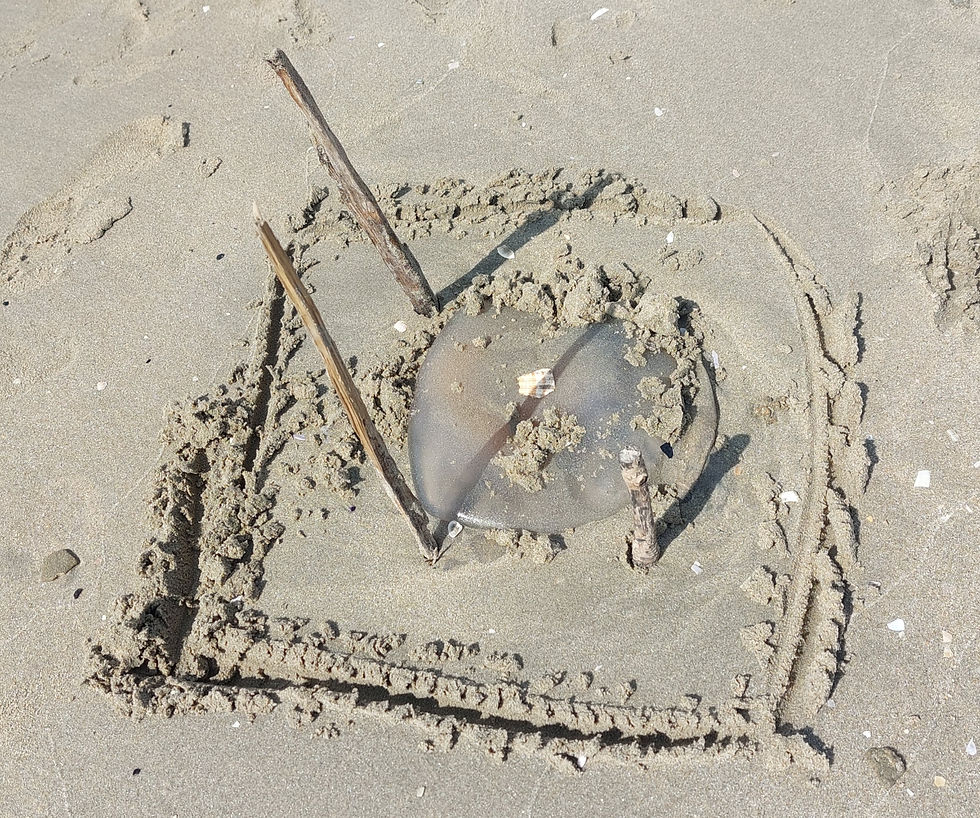
I was walking down the beach, and I saw familiar scenes: children sculpting various sand figures, such as turtles, sharks, and sandcastles; adults sunbathing or swimming in the sea. Nothing seemed out of the ordinary. Never would I have imagined that after half an hour of walking, I would stumble upon something unexpected: two children with their father carefully shaping a grave for a jellyfish. They were outlining the dead body with sticks, decorating with seashells, putting sand on the top, and tracing a square around it. The children were singing a song. Curious, I greeted the father, introducing myself, and asked if he would mind sharing what was happening. He smiled and began to tell me their story. A few months earlier, the family had lost their beloved dog to illness. For six years, that dog had been an incredible companion, and the loss had left them all in deep pain. As the children played close to the sea, they saw a lifeless jellyfish. To them, it didn’t feel right to simply leave it there alone. Remembering how their own dog had been buried, they decided the jellyfish, too, deserved the same respect—a grave of its own.
Is it normal to feel his way?
Yes, it is. In fact, animal grief following the loss of a pet can be just as profound and challenging as grief after the death of a human loved one (Clearly et al., 2022), and it is far from uncommon. Reports of such grief have been documented across countries for decades. An example is an early Canadian study from the 2000s in which approximately 30% of participants experienced severe grief following the death of a dog or cat (Adams et al., 2000). Reported reactions included both physical and emotional symptoms such as insomnia, loss of appetite, a deep sense of emptiness, persistent preoccupation with memories of the deceased pet, and intense difficulty accepting the absence of the animal in familiar places. Similarly, a more recent study from 2013 in Japan revealed that 56.1% of pet owners experienced severe grief. This research included owners who had lost not only dogs and cats, but also chickens, parakeets, rabbits, and hamsters.
An understanding of the depth and recurrence of loss emerges not only from academic literature but also from professionals' practice.
Sarah Hoggan, an emergency veterinarian with over 20 years of experience, has witnessed countless pet owners grieving the loss of animals of all kinds. She describes in detail the complex emotions people feel in the face of loss, while also emphasising how society often diminishes or overlooks them.
All information above highlights that if you are struggling with the loss of a pet, you are certainly not alone. Given the depth of pain that you and others may experience, here is a question to you: Is it better to have loved and lost than never to have loved at all? Share your thoughts in the comments below.
References
Clearly M., West S., Thapa D., Westman M., Vesk K., Kornhaber R. (2022) Grieving the loss of a pet: a qualitative systematic review. DOI: 10.1080/07481187.2021.1901799
Adams C., Bonnett B, Meek A. (2000) Predictors of owner response to companion animal death in 177 clients from 14 practices in Ontario. DOI: 10.2460/javma.2000.217.1303
Kimura J, Kawabata H, Maezawca M. (2013) Frequency of neurotic symptoms shortly after the death of a pet, Journal of Veterenary Medical Science. DOI: 10.1292/jvms.13-0231


Comments